
The Kahn's Space
- Valentina Silva
- 13 mar 2016
- 3 Min. de lectura


“…Architecture is the reflective elaboration of spaces. It is about the creation of spaces that evoke a feeling of appropriate use” Louis Kahn.

A decisive episode in Kahn’s work was his journey to the countries of ancient cultures. Kahn was shrouded in fog until the moment he stood in front of the monolithic spaces. From then on everything was clear to him. The timelessness, the persistence and stateliness of such ancient cultures would be applied in his modern architecture. Said characteristics could only be made with the right materials and he knew this perfectly. In the nature of the space is the spirit and the will to exist in a certain mode.
And because Kahn believed that the dark shadow is a natural part of light, Kahn never attempted a pure dark space for a formal effect. For him, a glimpse of light elucidated the level of darkness: “A plan of a building should be read like a harmony of spaces in light. Even a space intended to be dark should have just enough light from some mysterious opening to tell us how dark it really is. Each space must be defined by its structure and the character of its natural light.” As a result, the light as a source is often hidden behind louvers or secondary walls, thus concentrating attention on the effect of the light and not on its origin.
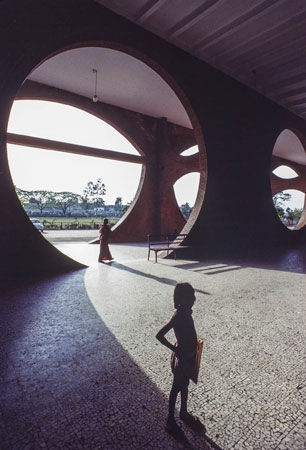
Assembly of Bangladesh
The “mysteriousness” of shadow was also closely linked to evoking silence and awe. For Kahn, while darkness evokes the uncertainty of not being able to see, of potential dangers, it also inspires deep mystery. It is in the hands of the architect to evoke silence, secret or drama with light and shadow - to create a “treasury of shadows,” a “Sanctuary of Art.”
Ayub National Hospital
Kahn´s path of designing with shadow attracted numerous followers, like Tadao Ando with his Church of Light, Peter Zumthor and his Therme Vals or Axel Schultes with his Crematorium. They all include shadow as a form giver for silent spaces. This perspective presents a pleasant counterpoint in today’s architecture that strives for dynamic and bright icons.
“Architecture", declared Kahn, ‘is the thoughtful making of spaces.’ His work contains many examples of indoor and outdoor rooms conducive to meditation.


Kimbell Art Museum Assembly of Bangladesh
The Beaux-Arts discipline of the architect’s education served him all his life when it came to organizing ceremonial. But before the stage of articulation there was the stage of discovery and with each design Kahn sought out a central idea, a crystalline form of thought, which brought the whole thing alive. He often reverted to centralized spaces surrounded by fringes of secondary ones to give shape to institutions, whether libraries, parliament buildings or dormitories. The plan of an ensemble, including interior and exterior spaces, was the visual equivalent to a ‘society of rooms’.

Theatre Fort Wayne

In the Salk Institute, Kahn uses spaces in a particular manner. He creates a courtyard between his buildings to frame the sea, generating a powerful space that organizes the institute. Kahn differentiates served and servant spaces by placing them in strategic points. Served spaces are placed where the morning light fills them, creating calm ambients for work with sights to the sea.
Salk Study

He also was concerned with creating strong formal distinctions between served spaces and servant spaces. What he meant by servant spaces was not spaces for servants, but rather spaces that serve other spaces, such as stairwells, corridors, restrooms, or any other back-of-house function such as storage space or mechanical rooms.


Comentarios